Friday, November 20, 2009

California 1/1/2010 Mod Calculation Change Advisory

by Kory Wells with Jeff Adcock and Tony King

ModMaster update 09.11, available to our clients on Friday, November 20th, includes support for the California rates and the split calculation change recently approved by the California insurance commissioner, effective 1/1/2010. If you do business in California - whether you use ModMaster or not - you need to be aware of how these changes may affect your or your client's workers compensation mod.

Our actuaries have been analyzing the data, and it's going to take us a few more days to get more details in a form to share with you. (Don't miss our previous post that excerpts the WCIRB summary of changes.) But we wanted to go ahead and alert you to a few key principles that may affect your mod under the new rules:

1. Our actuaries have determined that, on average, expected loss rates (ELRs) have decreased 6.4%. In fact, over 100 payroll codes had ELR decreases of 10% or more. While your results will depend entirely on the mix of payroll codes in your mod, an overall decrease in ELRs means that, if everything else stayed the same in your mod, you would have a good chance for your mod to increase in 2010.

2. An important loss level to keep in mind is $24,500. Under the new primary/excess split method, losses under $24,500 will have a greater primary value than they did under the old method. Since primary losses affect the mod more than excess losses do, this is another factor that may drive your mod up, especially if you tend to have more smaller losses than very large losses. Losses over $24,500 will generate a lesser primary value than they did under the old method, so if you have only losses over $24,500, this may benefit your mod.

3. The best defense is to be prepared for a mod increase, and a good way to do that is to compute your old mod with the new rates and split method. In ModMaster, this is easy to do (remember, you must be on update 09.11, code level 091118, or later):
  • Select the desired mod file with a 2009 effective date, and note the current mod value. Use the Utilities/Copy feature to make a copy of the file with a new name.
  • On the Company Setup page, change the effective date to 1/1/2010. Don't worry that this isn't the policy anniversary date, and don't change any other policy dates or other data.
  • Calculate the mod and see what the 2010 value would be. You may want to look at your favorite ModMaster reports for the 2009 vs. 2010 files side-by-side, but don't forget that the Mod Comparison report will do a quick comparison for you.
Of course, in the real world, your 2010 mod will have different payroll and loss amounts due to the oldest policy period leaving the experience period and the new policy period coming in. In the real world, there are also a lot of other moving parts to the mod formula aside from the ELRs and the primary/excess split values. Certainly not everyone is going to see a mod increase, and some entities will see a decrease. But our testing and analysis has revealed some cases of attention-getting mod increases.

More details of our analysis are forthcoming. In the meantime, we'd love to hear from our users how the 2010 changes appear to impact the mod files they run with a 1/1/2010 effective date in ModMaster.

Wednesday, November 18, 2009

How Will the 1/1/2010 California Workers Compensation Split Formula Change Impact the Mod?

by Kory Wells with Jeff Adcock

The fact that California Insurance Commissioner Poizner has once again rejected an increase in workers compensation pure premium rates (read the November 10th Insurance Journal article California's Poizner Rejects Workers' Comp Increase Request, Again) is almost overshadowing the fact that he approved other changes that will interest workers compensation agents and others advising clients in the work comp arena.

As stated in the WCIRB's November 9th announcement:
The Insurance Commissioner approved amendments to the USRP include changes to the Standard Classification System and the elimination of the requirement of insurers to report social security numbers due to privacy concerns. The approved amendments to the ERP include (a) changes to the eligibility threshold, (b) classification expected loss rates, (c) the split formula used to segregate individual claims into their primary and excess components and (d) the ERP credibility ("B" and "W") values.
This announcement undoubtedly prompts questions such as:

How will these changes to the California rating plan affect the mod?
Part B of the 2010 Regulatory Filings posted on the WCIRB site goes into the changes and their anticipated impact in great detail. A brief summary (emphasis ours) lies in this sentence from page B:C-12:
While this methodological enhancement will improve the accuracy of experience modifications, the 2010 experience modifications for some employers will be impacted.
For those of you who are interested in learning more about the anticipated impact on the expected loss rates and the mod, we've packaged an excerpt of Part B in pdf form.

The first page (B:C-12) of the excerpt has a chart showing the impact on expected loss rates (not the mod itself) by industry sector that may be of interest. As you can see, real estate, arts and entertainment, and outside sales are some of the areas where the expected loss rates will change the most, with utilities and construction, education, and administrative also showing fairly significant impacts.

The second page (B:C-36) of the excerpt makes it clear that while the overall statewide average mod is NOT going to change, there will be some variability. The following pages, Exhibits 2.1 through 2.7, show the expected variation in the mod by size of account as measured by expected losses (Exhibits 2.1 through 2.5) and then by existing mod (Exhibits 2.6 and 2.7).

One of our actuaries, Jeff Adcock, consolidated the exhibit data into this spreadsheet (also available in pdf format) so you can have a one-page overview of the estimated impacts. The interesting thing about the existing mod analysis is how current risks with a mod of over 1.00 have a higher percentage of anticipated increase. Jeff is continuing to study the WCIRB documentation and may provide further analysis here on this blog, as warranted.

When will these changes be available in ModMaster?
The change in the split formula requires a ModMaster programming change. We were already working on this change prior to the commissioner's approval and now have it in testing. This change - along with the new expected loss rates and B and W values - should be available within a couple of weeks.

In the meantime, if you already have 2010 California mods that you could share with us for testing purposes, we'd certainly appreciate you doing so - contact support for more information.

Friday, November 6, 2009

Training Videos Help Address OSHA's Top 10 Safety Violations for 2009

by Kory Wells, WorkCompEdge Blog Editor

As reported on several news and blog sites in the past several days, OSHA has recently released its preliminary list of top safety violations for 2009. As stated in the full release on PRNewsWire, which came from the National Safety Council,
The number of top 10 violations has increased almost 30 percent over the same time period in 2008.

"We appreciate our colleagues at OSHA presenting their new violation data to such a receptive audience," said National Safety Council President and CEO Janet Froetscher. "The sheer number of violations gives us new resolve in raising awareness about the importance of having sound safety procedures."
"So what's up with the 2009 spike in OSHA safety violations? Have layoffs, emotional states, and other fallout from the financial crisis stressed workers to the point of making bad safety decisions? Or have the OSHA inspectors just been especially diligent this year?"growth

So what's up with this spike in violations? And will this correlate to an actual increase in workers comp claims in 2009, something we suggested might happen when the global financial meltdown occurred? We're not saying we told you so...we're wondering along with you what's going on. Have layoffs, emotional states, and other fallout from the financial crisis stressed workers to the point of making bad safety decisions? Or have the OSHA inspectors just been especially diligent this year? Regardless of the cause, as Ms. Froestscher points out, clearly there's a need to mitigate this trend.

So, this is a good time to remind you of the WorkCompEdge Safety Training Center, which allows each of a company's employees to take web-based video courses on desired subjects, answer a quiz at the end of each course, and, if he or she earns a passing grade, receive a certificate of completion for that subject. With over 40 videos on a diverse set of safety topics, including defensive driving, disaster planning, hazard communication, noise and hearing protection, recordkeeping, and more, it's sure to have something for everyone - and addresses much of the top 10 list of violations. Here's the list, along with the related video(s):

1. Scaffolding - 9,093 violations
Scaffold accidents most often result from the planking or support giving way, or from the employee slipping or being struck by a falling object.

See the WorkCompEdge Safety Training Center video Scaffolds in Construction

2. Fall Protection - 6,771 violations
Any time a worker is at a height of four feet or more, the worker is at risk and needs to be protected. Fall protection must be provided at four feet in general industry, five feet in maritime, and six feet in construction.

See the WorkCompEdge Safety Training Center video Fall Protection in Construction

3. Hazard Communication - 6,378 violations
Chemical manufacturers and importers are required to evaluate the hazards of the chemicals they produce or import and prepare labels and safety data sheets to convey the hazard information to their downstream customers.

See the WorkCompEdge Safety Training Center video Hazard Communication. Note that there's a separate Hazard Communication for Healthcare Workers video.


4. Respiratory Protection - 3,803 violations
Respirators protect workers against insufficient oxygen environments, harmful dusts, fogs, smokes, mists, gases, vapors, and sprays. These hazards may cause cancer, lung impairment, other diseases, or death.

See the WorkCompEdge Safety Training Center video Respiratory Protection

5. Lockout-Tag out - 3,321 violations
“Lockout-Tag out” refers to specific practices and procedures to safeguard employees from the unexpected start up of machinery and equipment, or the release of hazardous energy during service or maintenance activities.

See the WorkCompEdge Safety Training Center video Lockout-Tagout - Authorized Employee

6. Electrical (Wiring) - 3,079 violations
Working with electricity can be dangerous. Engineers, electricians, and other professionals work with electricity directly, including working on overhead lines, cable harnesses, and circuit assemblies. Others, such as office workers and sales people, work with electricity indirectly and may also be exposed to electrical hazards.

This violation is in part addressed in the WorkCompEdge Safety Training Center videos Electrical Safety - Unqualified Worker and Arc Flash Safety


7. Ladders - 3,072 violations
Occupational fatalities caused by falls remain a serious public health problem. The U.S. Department of Labor (DOL) lists falls as one of the leading causes of traumatic occupational death, accounting for 8% of all occupational fatalities from trauma.

See the WorkCompEdge Safety Training Center videos Slips, Trips, and Falls and Fall Protection in Construction

8. Powered Industrial Trucks - 2,993 violations
Each year, tens of thousands of injuries related to powered industrial trucks (PIT), or forklifts, occur in U.S. workplaces. Many employees are injured when lift trucks are inadvertently driven off loading docks, lifts fall between docks and an unsecured trailer, they are struck by a lift truck, or when they fall while on elevated pallets and tines.

See the WorkCompEdge Safety Training Center videos Forklift Operator Safety and Introduction to Rough Terrain Forklift Safety

9. Electrical (general) - 2,556 violations
See #6.

10. Machine Guarding - 2,364 violations
Any machine part, function, or process that may cause injury must be safeguarded. When the operation of a machine or accidental contact injures the operator or others in the vicinity, the hazards must be eliminated or controlled.

See the WorkCompEdge Safety Training Center video Machine Guarding

Registration for the Safety Training Center is located in the Download and Online Tools section of the "Four" Safety module of WorkCompEdge. There are several other tools there that may also help improve your company's safety culture and record, including a safety commitment statement, a safety culture survey, a safety measurement tool, and more.

Let us know what you think about the increase in violations this year, and other ideas for addressing this issue.

Wednesday, October 21, 2009

Comparing Two Workers Compensation Experience Mods

by Kory Wells, WorkCompEdge Blog Editor

Many of our readers have found themselves, at one time or another, in the unfortunate position of trying to explain why the workers compensation mod went up from the previous experience period. The possible culprits are numerous and have a lot of moving parts: changes in
  • expected loss rates,
  • payroll,
  • overall loss experience, or
  • the mix of loss types (frequency, severity and/or medical-only losses)
all contribute to a change in the mod. Of course, a change can be positive or negative depending on all the moving parts. Mod increases will occur, even if loss levels remain the same, if expected loss rates fall. Business owners don't expect to pay more in premium when their business is down, but it's definitely possible. So how do you get a handle on what exactly is influencing a mod - and premium costs - from one experience period to the next?

We know you already use ModMaster to calculate and analyze the experience mod calculation (What? You don't? Learn more about ModMaster now), so in the past you would've undoubtedly used one of our many reports - perhaps the Loss Analysis by Policy Period, for example - to help see what's happened with the mod from one rating effective date to the next. Still, that involved selecting the desired mod file and requesting the desired reports, then opening up the mod file for the previous experience period and requesting those reports. So much paper and time and looking back and forth from one page to another.

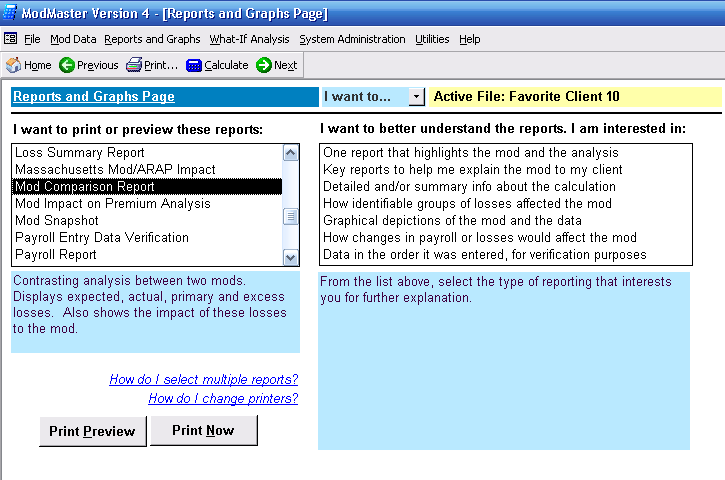
Find the new Mod Comparison report on the Reports and Graphs page of ModMaster.

But now (drum roll, please), that's all changed. The new Mod Comparison Report, available in ModMaster update 09.08 and later, produces a two-page report that shows critical information for both the current mod file and a second mod file of your choice. Here's how to use this report for best results:

1. First, let's say that you have the 2009 mod for Favorite Client already loaded into ModMaster. You're ready to put in data for the 2010 mod. Start by doing a File Utilities/Rollover of the Favorite Client 2009 to a new name, let's say Favorite Client 2010. This deletes the oldest policy year of data (in this case the 2005 policy year) and "scoots" all the other data over on the payroll and small loss pages so that the newest column is empty and awaits your data input.

2. Input payroll and loss data (either estimates or actuals, if you have the data) for the newest policy data into the Favorite Client 2010 file. This would be the 2008 policy period for our example. Also make any other adjustments to existing payroll or losses to match the bureau worksheet.

3. Calculate the mod. If there are no errors, then proceed to the Reports Menu.

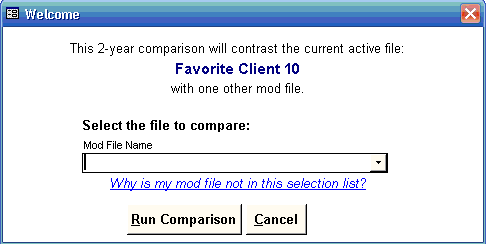
4. You'll see that the Mod Comparison report is now a choice on the Reports Menu. When you click on this report and then click "Print Preview" or "Print Now," the following dialog appears:

Mod Comparison report dialog

5. Now, here's the important part: when you pull down the list of mod files, be sure to select the mod file for the same risk but only one year earlier. While ModMaster will attempt to compare any two files you indicate, this report is designed to compare mods that differ by one and only one experience period. If you try to compare other mods, unpredictable results may occur, as we say in the software business.

6. After you select the mod file to compare to, click the "Run Comparison" button, and something like the following will print or preview. (Click the report image to view the report as a pdf.)


Mod Comparison sample report, page 1

Mod Comparison report, page 2

At a glance, you can see how much the mod changed from year to year, but just as importantly, how much the minimum and controllable mods have changed. You can also see what's happened with the expected and actual losses: whether they've gone up or down, and what's happening with actual to expected ratios.

In this case, we can see that the mod went up, not only because expected losses were down but also because the actual losses which dropped out of the calculation were less than the actual losses which were added for the 2008 policy period.

The new Mod Comparison report is based on a user suggestion we greatly appreciate. We've already had a new suggestion from a different user that we should also list payroll totals, not just expected losses. Give the report a try today and let us know what you think!

Wednesday, October 7, 2009

Take Our Collateral Survey

by Kory Wells, WorkCompEdge Blog Editor

As a follow-up to Michelle Bradley's recent blog article "A 2009 Collateral Perspective," we've decided to conduct a survey of professionals currently involved in collateral issues related to self-funded workers compensation liabilities.

We invite insurance brokers, risk management consultants, and risk management staff of self-funded concerns to participate in the survey, which will be open through the month of October.

The goal of the survey is to assess, on a national basis, trends in collateral negotiations, exposures, reviews, arbitration, litigation, and other factors that SIGMA has seen with its own clients this year.

Our privacy policy: At the end of the survey, we ask you to register if you'd like us to share survey results directly with you. We'll also be posting at least some of the survey results on this blog and possibly in other venues. If you supply your email address, we'll also send you an invitation to join our newsletter list. We will NOT be sending any other emails or contacting you further, nor will we share your personal data with anyone else. Also, no personally identifiable information will be shared in any survey results we publish.

The survey takes about 5 minutes to complete, and (enticement alert) you get not one, but two, special free offers at the end. Take our collateral survey now.

We appreciate your participation!

Wednesday, September 23, 2009

Improve Your Cash Flow with Pay-As-You-Go Workers Comp

by Frank Pennachio, WorkCompEdge Regular Contributor

Workers compensation policy premiums are usually based on estimated payrolls. The final earned premium is determined during a premium audit after the policy expires and is based on actual payroll. When payroll is higher than estimated, the employer owes additional premium, and when payrolls are lower than estimated, money is returned. In current economic conditions, many employers’ payrolls are declining, so an employer may be paying higher than necessary monthly installments due to an overstated payroll estimate at the inception of the policy.
paywindowIn these challenging times where cash flow is king, employers might want to consider another work comp insurance option known as Pay-As-You-Go.
View the full blog at http://workcompedgeblog.com/

Wednesday, September 9, 2009

A 2009 Collateral Perspective

by Michelle Bradley, SIGMA Actuarial Consulting Group

In October 2006, Lloyd Kelly and I authored a paper titled “Reducing Collateral Uncertainty: A Primer for Negotiations” that was published in Risk Financing Perspectives for the International Risk Management Institute. We expanded the paper in 2008 and published it as “Reducing Collateral Uncertainty” for the Institute’s Risk Financing Manual.

financials
For the purposes of this article, collateral is one type of security that can be provided to a fronting carrier or regulator by a self-insured entity for the credit risk assumed by the carrier or regulator.
View the full blog at http://workcompedgeblog.com/